

👁 EYES ON YOU
A small kinetic light installation exploring layered imagery, perception, and motion.
Overview
Type: Small Installation / Light-Based Kinetic Sculpture
Role: Concept Designer, Fabricator, Circuit Designer, Arduino Programmer
Tools: Acrylic engraving, Laser cutter, 3D printing, Arduino UNO, LED strip, Hand wiring
Team: Solo project
Course: IDEA292 – Interdisciplinary Project Lab
Exhibition: Gribbel Room Final Project Showcase, December 11,2024
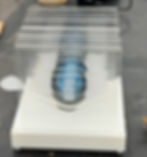
Eyes Box is a compact light installation inspired by layered imagery, optical illusion, and early animation theory. Inside the 3D-printed box, engraved acrylic plates create a shifting “eye” form that animates when illuminated from different angles. It is a physical exploration of how sequential images and moving light can imitate motion.
Background & Inspiration
The piece draws inspiration from the sculptural work of David Spriggs, whose use of layered transparent planes creates floating, dimensional images that seem to exist between realities. At the same time, I was thinking about classical animation theory: the idea that “continuous images presented in rapid succession become motion.” I wanted to merge these two influences into a small physical object: a space where light, layers, and perspective create animation without screens.
The “eye” motif came from questions about perception:
What does it mean for a still object to feel like it is watching, or alive?
How much motion can be suggested with nothing but light and layers?
Process
1. Visual & Concept Development
I designed the eye in 6–8 sliced layers, testing how the engraving lines would catch and scatter LED light. I studied how Spriggs manipulates transparency and how classical animation relies on incremental transformation. My aim was to create an object that looks static at first, but shifts into motion when illuminated.

2. Fabrication (3D Printing + Laser Cutting)
Built the outer box in PLA with precise tolerances for inserting the acrylic sheets
Laser-engraved the acrylic plates with slightly varied shapes so they “interfere” subtly under light
Experimented with textures to control how much light each surface diffused or reflected
3. Electronics & Arduino Programming
Before this project, I had zero electronics experience. I learned:
Breadboard wiring
Resistor calculation
Basic Arduino programming
LED control patterns (fade, pulse, alternating channels)
I built a small internal circuit that sequences LEDs to produce a “breathing” or “opening” eye effect.

4. Troubleshooting & Iteration
Much of the final week involved solving electrical problems, redesigning joints inside the box, and refining the lighting sequence.Even with imperfections, the final visual quality exceeded expectations: the eye appears to expand and contract subtly, giving the illusion of motion.

Outcome
The installation was exhibited at the Interdisciplinary Project Lab Final Showcase.
Students and visitors reacted strongly to the ethereal quality of the piece, and many were surprised to learn that the effect came only from layering, not actual moving parts.
Reflection
This was my first time working with electronics, Arduino, and 3D fabrication, and the learning curve was steep but rewarding. The piece taught me how light itself can be a narrative mechanism, shaping mood and suggesting movement.
I realized how much control engraving patterns, line weight, and acrylic textures have over perceived motion. Not everything worked perfectly—especially the internal wiring, but the imperfections helped me understand systems thinking in physical computing.


